

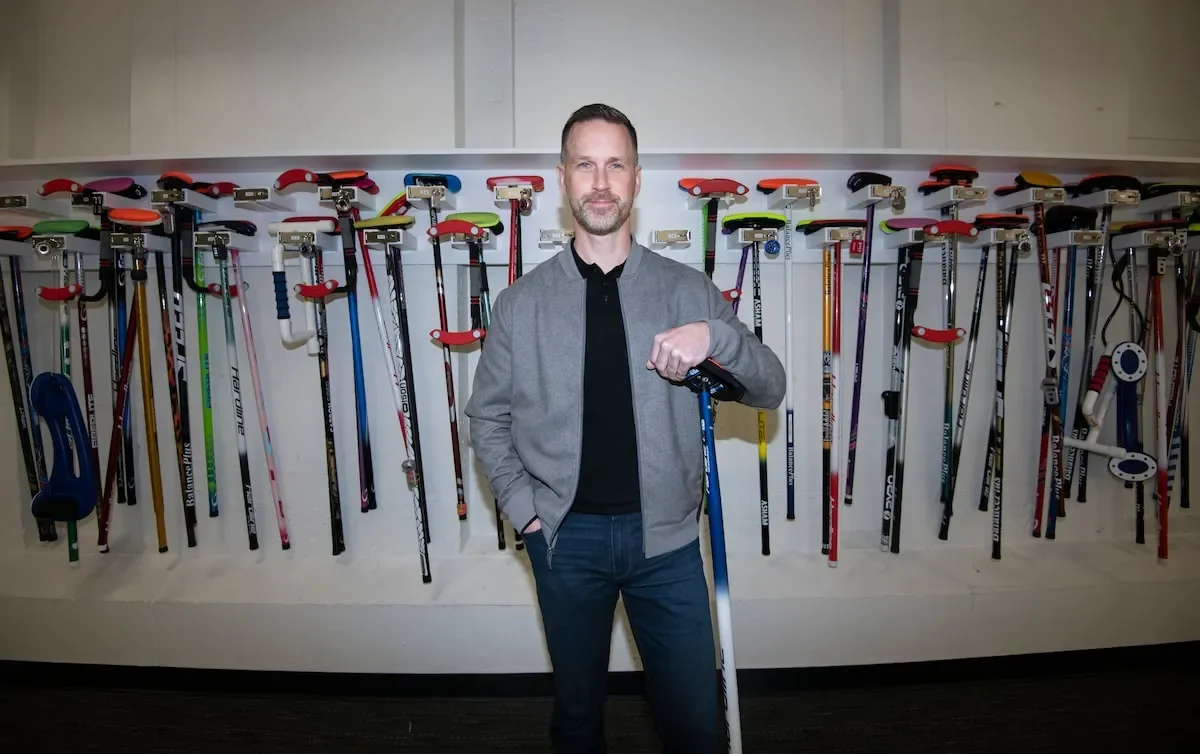
A few weeks before Brad Gushue flew into Toronto to talk about his frank memoir, his publicist sent along an apologetic message noting that the former champion hadn’t done any curling since taking a final, teary bow at the Brier, and that his last few seasons had been plagued with injuries. All of which meant he wouldn’t be able to throw any rocks for a photo shoot following an interview.
Standing in the chill of a Toronto curling pad waiting for a photographer to set up some lights, Gushue admitted the issue was more emotional than physical. After more than two decades as one of the world’s top curlers, he wasn’t ready to be confronted with what he suspected would be his own fading skill.
As a teenager, he explained, he had won several golf competitions before giving up the game for curling. When he hits the links now, it brings immense frustration because he feels he should still be able to perform. Joining the ranks of casual curlers chucking granite for fun once a week holds little appeal when he knows he will expect to make a difficult shot and grow angry with himself upon missing.
Returning to play without competing at the top level breeds resentment toward the game, leading him to conclude that staying away is better.
That relentless drive served as a superpower for Gushue ever since he emerged from his hometown of St. John’s in the early 2000s as a brash twentysomething from a province not widely known at the time for curling talent. In his memoir, Gushue:
- The Making of a Champion
- written with journalist Stephen Brunt
- he acknowledges that this approach came at a significant cost.
A few more rocks, a few more practices, and a few more reps formed his constant mentality, creating moments back then when he needed someone to step in and tell him to stop.
With those habits now halted, the question remains where that obsessiveness goes.
He admits he does not know, sitting in the club lounge before the photo shoot with his hands clasped tightly in his lap. While he has plenty of projects underway and considers himself too busy, nothing qualifies as a new North Star in his life.
He realizes realistically he is unlikely to find something of that exact magnitude, though finding an outlet for a little bit of passion would be welcome. Yet another side of him questions whether there is something else out there to devote his life to entirely, creating an internal battle.
Pausing to point at his head and give it a slight shake, he remarks that he remains a mess up there.
Revelations in His Memoir
In The Making of a Champion, Gushue offers a forthright, emotional, and revealing look back at his two decades in the spotlight, taking readers behind the scenes and into his anxious thoughts during major triumphs such as Team Gushue’s gold-medal win at the 2006 Turin Winter Olympics.
He reveals that his family kept him in the dark during the tournament about a health battle his mother was waging so he would not lose focus.
News from home still leaked through when teammate Jamie Korab logged on at an internet cafe and learned that Newfoundland and Labrador Premier Danny Williams had closed schools so children across the province could watch the gold-medal game. Feeling the immense weight of provincial and national expectations, Gushue barely slept before delivering a dominant performance that won Canada its first Olympic gold in men’s curling.
Upon returning home, the team received a thunderous airport welcome, though the joy soon curdled. Gushue writes in his memoir that he returned to the gym three days later out of fear that failing to repeat his triumph would cause people to dismiss him as a fluke.
Reflecting on that period, Gushue admits he was the one who feared his success was a fluke. At age 25, he did not feel he had truly earned the win or suffered enough hardship to deserve it, noting that the success came too easy. He felt pressure to quickly win a Brier, though it ultimately took another 11 years to raise the tankard for the first time.
Hard Lessons in Leadership
Hardships followed. In the spring of 2007, after Gushue and teammate Mark Nichols decided Korab lacked sufficient focus, they cut him loose, leading to a bitter fallout. People across the province and within his home club took sides, directing angry criticism and hate mail at Gushue for perceived disloyalty.
The episode left him scarred, withdrawn, and cautious in social settings, fundamentally changing his outlook on others.
Over time, he began to understand how he might have handled that and other incidents differently. Having grown up admiring gruff hockey coach Mike Keenan, who won the Stanley Cup with the New York Rangers and believed in pushing people hard to get results, Gushue had imported that normal-seeming mentality directly into curling.
Only after his mentor, Toby McDonald—who played on the rink that won Newfoundland’s first Brier in 1976—delivered hard truths about the bruising effects of his leadership style did Gushue begin to change, though not overnight.
Having spent 15 years being difficult, he suddenly needed to learn patience, empathy, and collaboration.
He evolved into a more understanding leader across both his curling teams and his outside business ventures. Because Olympic sports outside of hockey, basketball, baseball, and soccer rarely provide a living wage, Gushue built a life around curling through consulting, public speaking, and co-owning Orangetheory Fitness franchises.
Now he seeks grace and understanding as he navigates a new relationship with the sport that gave him so much.
The Decision to Retire
He had considered retirement for several years, prompted by a mix of factors. Despite winning a record six Briers, including three consecutively from 2022 to 2024, he felt mounting pressure where victories felt smaller and losses felt catastrophic, as though losing meant letting down his entire province.
He also felt like a grumpy old player resistant to change, recalling older competitors from his early days who opposed rules designed to improve the game. Recognizing that modern audiences with short attention spans require 30-second social media clips rather than three-and-a-half-hour matches, he acknowledges the sport must evolve, even if the new reality differs from the game he grew up loving.
He will nevertheless have a front-row seat to curling’s evolution through two new roles, one positioning him in Canadian living rooms and the other sparking some controversy.
New Roles Off the Ice
The controversial role came last spring when he was named director of high performance for USA Curling, a move that drew disappointment from some Canadians.
Pushing back gently, Gushue notes that curling jobs are rare and this remote position allows him to continue living in St. John’s with his wife and two daughters.
Describing it as strictly administrative, he explains that his duties involve allocating funds and determining the best training methods for athletes rather than waving flags or standing on the sidelines.
The position also leaves him time for his other new gig as a play-by-play commentator for the Grand Slam of Curling broadcasts on Sportsnet and CBC.
His broadcasting debut brought intense stress that left him more nervous than a Brier final.
Starting fresh at age 46 after being the best in the world at something else proves difficult, but once he moves past the initial anxiety, he sees potential for a new passion.